
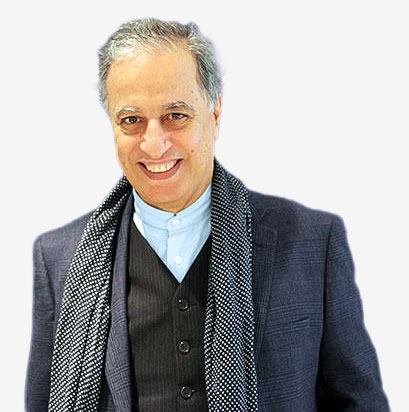
Prof. Driss Alaoui Mdaghri, a prominent figure in Moroccan society, is renowned as a scholar, former minister, author, columnist, and speaker. His multifaceted career spans various fields, including education, public management, entrepreneurship, art, and culture. Throughout his professional journey, he has significantly contributed to academia, public service, and cultural initiatives, demonstrating a commitment to advancing knowledge and fostering societal development.
Honors and Decorations:
Driss Alaoui Mdaghri’s contributions to society have been recognized with prestigious honors, including the Ouissam Al Arch and the Legion of Honor. These decorations reflect his significant impact and service to his country and beyond.
Residency period
From 8th January to 8th October 2024.
Education:
Driss Alaoui Mdaghri holds a Doctorate of State in Law from the University of Nice and a Diploma of Higher Studies in Sociology from Mohammed V University. His academic background reflects his interdisciplinary approach, blending legal expertise with sociological insights.
Career Highlights:
- • Minister of Communication and Government Spokesperson (1995-1998).
• Minister of Youth and Sports (1993-1995).
• Minister of Energy and Mines (1990-1993).
• Secretary of State for Foreign Affairs in charge of the Arab Maghreb Union (1989-1990). -
Residency at IAS-UM6P:
During his residency at the UM6P Institute for Advanced Studies, Driss Alaoui Mdaghri devoted his time to the writing of his memoirs, conceived as a two-volume work retracing more than half a century of intellectual, cultural, and public engagement. The first volume, Les Sentiers qui bifurquent – Aube, unfolds as a reflective journey at the crossroads of poetry, philosophical inquiry, and civic commitment. Rather than a conventional autobiography, the book offers a meditation on the questions that have shaped his vision of the world: the search for peace in times marked by conflict, the exploration of imagination—from science fiction to chess—and the constant dialogue between tradition and modernity. Through personal memories, cultural initiatives, and intellectual engagements, Mdaghri sketches the portrait of a country in transformation while reflecting on the role of thought, creativity, and public service in shaping collective futures. His narrative weaves together the private and the public, memory and anticipation, tracing the path of a life attentive to the bifurcations that give meaning to human experience.
Appointed in March 1989 as Secretary of State for Foreign Affairs in charge of the Arab Maghreb Union, he was described by King Hassan II as a man “marked by wisdom and moderation,” a recognition that echoes throughout the reflective tone and historical depth of his memoir project.